Showing posts with label n2teaching. Show all posts

Tuesday, February 21, 2012

Tuesday Trait: Sentence Fluency

We follow deer tracks in the mud, pretending that we too are wild beasts.
and so it begins! What happens when you prejudge a book recommendation from a colleague simply because of its name or its audience? For me, that's pretty rare, yet it happened with Guyku. Because I trust the educators of my PLN (Professional Learning Network), I changed my mind, I read Guyku. It's great, so I say, "Go with it!" With that in mind, I've decided to review this highly recommended book with a specific audience. I'm wondering if children who read Guyku will really care that the title makes it sound like it's a book for boys, yet I think most young ones will enjoy this book. I just read GUYKU, because of this trust within my Professional Learning Network. This book would be a satisfying read for boys or girls. While, the story of Haiku for guys sounded like a book that only a boy could love, I was impressed that the story would probably be well received by boys or girls. As I have written on many Tuesdays, I'm giving GUYKU the Six Traits of Writing treatment. While this book could be used to teach many traits, especially WORD CHOICE and SENTENCE FLUENCY. I selected SENTENCE FLUENCY because I think the Haiku message can be taught within the context of the fluency trait. In Guyku, each sentence is written in the poetic form of Haiku, yet the style and meter of each sentence is NOT repetitious. Quite the opposite. With sentences like
Hey, who turned off all the crickets? I'm not ready for summer to end....
and
With baseball cards and clothespins, we make our bikes sound like motorcycles....
it appears to me that this is a great opportunity to show your students how cool varying sentences in a similar (Haiku) format can be. Join me. Review this book.
Other educators who have spoken high praise for GUYKU: IMAGE: "Join the Guyku Club" by Peter H. Reynolds taken from the Guyku website.

Tuesday, February 14, 2012

Tuesday Trait: Ideas and Content

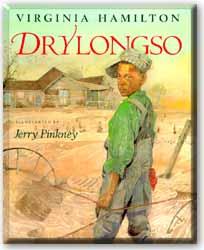
Tuesday's Trait: Ideas and Content highlights the story Drylongso. Drylongso BY Virginia Hamilton Illustrated by: Jerry Pinkey

Drylongso is a realistic fiction story, set in the 1970's. It is the tale of a farming family in the drought-stricken Great Plains or Midwest. The story could have happened in one of the many places with red dirt, including the Oklahoma Panhandle. The ideas and content of this picture book make is a great candidate to encourage and practice effective writing among older elementary students. The story is mature enough that it could be used as examples for middle school students. The big idea of this story is how natural forces can reinforce poverty. The poverty refers to the low economic standing of subsistence farmers, especially among African Americans in the drought stricken region. The poverty is represented by the meager types and amounts of food, lack of water, and other primary needs. Lindy's family in the story Drylongso never went hungry, but they were always on the verge of hunger. This could be a great opportunity to begin a conversation about hunger. First, define: What is hunger? This could be a lively discussion, because some may believe the tiny twinge when a meal is a few hours late describes hunger. Many of them may never know what it is like to be truly hungry and go without food for more than a day. While this could be a tricky topic, you will do well if you ask the students to share their stories in the third person. For example, you could ask, "Do you know anyone who has ever told stories of being hungry?" If they tell stories about themselves, it might be best if others don't know. That is one purpose for using the third person. They may know relatives who lived through The Great Depression of the 1930s, and they can tell their stories. Telling stories would be a great opportunity to develop related projects and tell the stories of your students' families. Students could interview friends and relatives and make a presentation. If your students don't have anyone who might have been hungry, you could use Skype or some other communication device and interview some people who lived through hunger times here in the United States of America or other countries. The secondary, yet important idea of the story is the drought itself. The drought is so pervasively discussed in the story that it really becomes one of the characters. Briefly, yet powerfully, the author discusses the drought using ideas and content that make you feel dry, dirty and tired from all the work that must take place to avoid the major problems of the drought. The description of the dust storm is very realistic. As an introduction to an important character, Nature, Virginia Hamilton does discuss the 20 year cycle of droughts in the setting. The turning point in the story is the dust storm that brings a new character, Drylongso. He arrives as an enormous dust storm spins into the story. His arrival is reminiscent of a modern day, muted Pecos Bill riding a dust devil into town. Drylongso, a boy a bit older than the family's daughter Lindy, is taken in by Lindy's family. They give him water to drink and use to clean his face, and they feed him. Drylongso tells the family how he was separated from his father during the dust storm and became lost. As the conversations continued, Drylongso revealed that he could use a dowsing rod to find water. Then he uses his dowsing rod to locate an underground spring in the dry creek bed that can be used by Lindy's family to help improve their water situation. They can water their animals and their garden, and this new water source is an inspiration for new positive feelings about their situation. Having helped the family, Drylongso says he must return to his father, and he disappears into the West. Characters: Lindy MamaLu Dad Drylongso

Tuesday, May 25, 2010

Promote Global WORMING! Decomposers in the Biotic Pyramid


Primary succession, showing small tree growing with small amount of soil by Martin LaBar
Attribution-NonCommercial License
What is a Decomposer? What role do Decomposers play in the process of environmental succession within the Biotic Pyramid? What types of living things are considered Decomposers in the Biotic Pyramid? 

In the process of primary and secondary succession, bare rock becomes covered with plants, as well as animals. At first there is little soil, so life is tenuous. As time goes by, the decomposers and small plants begin to wear down the bare rock, and the variety of  life 
increases.

Succession in bodies of water, especially fresh water ponds and lakes is similar to bare rock succession. The difference is that water replaces the rock. Decomposers such as worms depend on a moderate level of water in the soil to survive, so they cannot live in either of the first stages of bare rock succession or pond succession.

To help students gain an understanding of succession, the leader (teacher) will use the Project Wild Aquatic activity, Pond Succession, found on pages 66-68. A fieldtrip to a variety of natural environments in the various stages of succession would be a wonderful way to provide students with an opportunity to see these NATURAL environmental changes.


The Beth Chatto Gardens Float My Boat! by antonychammond (playing catchup!)
Attribution-NonCommercial-ShareAlike License
The objectives of Pond Succession would be the same as that of Bare Rock Succession. If you wanted to substitute Bare Rock Succession for Pond Succession that is fine. Remember our focus is on the worms and similar decomposers, so the students will need information about the worm's habitat. Then the worms can be added into the right stage of either type of succession. The objectives are listed below.
In this activity, students will:
  1. recognize that natural environments are involved in a process of continual change.
  2. discuss the concept of succession.
  3. describe succession as an example of the process of change in natural environments. AND
  4. apply understanding by drawing a series of pictures showing stages in pond succession.
When the learners, students, apply understanding of succession, by drawing a series of pictures, showing stages of succession or keeping a log or diary of a related fieldtrip, the teacher should use this as their evaluation (assessment) for this activity.

Promote Global WORMING! Discover the Worms

Discover the Worms is a basic introduction to the various macroinvertebrates we know of as WORMS. Complete this activity after the PRIOR KNOWLEDGE ASSESSMENT. Based on information gathered from an online search, the students will:

  1. outline the basic ideas of the worm life cycle.
  2. illustrate the worm life cycle.
  3. compare and contrast their life cycle with that of an aquatic macroinvertebrate (see pages 25 and 38 for ideas).
  4. Add words to the Promote Global WORMING that provide more detail about worms.

Thursday, May 20, 2010

Math In All Its Forms: Diigo Webslides

Whenever you use the Diigo bookmarking web application, you may categorize your bookmarks in lists. Each list will contain all the bookmarks you put in that particular category, such as Math In All Its Forms. When you want to share the list with others, you have many choices, including webslides.

Webslides are screenshots of the front page of each webpage that you bookmarked within a particular list. This webslide presentation contains all the bookmarks for the list: Math In All Its Forms.

For those who cannot use Diigo on your network, you might consider Diigo for Educators. It's self-contained and has no advertisements. You may want to discuss this with the school's technology coordinator and gain access. Even if you can't access Diigo at school, you can use it for your own research and lesson preparation.

Wednesday, April 21, 2010

Winsome Wednesday: Moo Cards for YouTube Producers

Moo, an online printing service, is partnering with YouTube to help you get the word out about your videos. You can get a pack of 50 free cards. You can also have more than one image in your card set that come in your pack.

This is a wonderful idea. Moo helps you get the word out, and you also invite people to YouTube who may not know about your work.

Yes, believe it or not, there are people out in the World of Matter who don't know about YouTube. Don't you think they need to know?

Monday, March 22, 2010

Drops of Old Glory


drops of old glory
Originally uploaded by Steve took it
Amazing images that are shared with us are available to all students and teachers for use, as long as we follow the Creative Commons Share-Alike non commerical copyright. That's always easy to do, since we are teachers and students.

Tuesday, March 2, 2010

What are Effective Schools?

Yes, if you want to improve something, you must ask the right questions. How do you ask the right questions about making a community's high school effective? Find effective schools that resemble your demographics and implement similar strategies.

One concern from some readers might be with this point: "All students must learn the advanced skills that are the key to success in college and in the 21st century workplace...." What does that mean? Is the all4ed organization saying that all students should be required to go to college?

I'm wondering.

Is this the breakpoint where we raise compulsory education to the 14th grade?

I agree with all the ideas, but I'm wondering if the ten points might be clarified in a way that encourages more reader acknowledgment and acceptance. I believe that initial acceptance or tolerance for an idea will lead readers to a continued study the ideas presented. If some readers are put off by the language describing the first point, it may be difficult to get them to proceed to the other elements.

I believe in the effective schools movement where effective communication is the primary concern, the key to success, of any education reform.
clipped from all4ed.org

Regardless of their plans, all of the nation's young people need high-level knowledge and skills to achieve success in a rapidly changing world of technological advances and international competitiveness. And every American has a stake in their success, whether they have school-age children of their own or not.

children of their own or not.

How effective is your community's high school in educating its students?
You don't have to be a school superintendent or member of Congress to help the six million students most at risk of failing to graduate from high school. Drawing from the work of leading researchers and educators from around the country, the Alliance for Excellent Education has identified ten key elements that every high school should have in place to ensure that all its students are successful. The list includes challenging classes, a safe learning environment, and skilled teachers.

 blog it

Wednesday, January 27, 2010

Winsome Wednesday: Marsha! Marsha! Marsha!


Your regularly scheduled Winsome Wednesday will be interrupted by the overwhelming news of the day: the introduction of the long awaited Apple iPad.

While the Apple iPad's name is already generating some discussion, overall the reviews have been very positive. It appears that most Apple lovers are glad to finally see a touch screen tablet with the Apple name on it.

What struck me immediately is that it's taken over a quarter of a century to even get close to the appliance that the technology gurus predicted we would have. Yes, it's the history of the joys of the free enterprise system. We were able to put a man on the moon within 8 years of predicting it, yet it's taken all this time to get here.

Well, here we are....a nice little appliance that you can purchase, so you can purchase more stuff from the Apple store. You will need to have an iTunes account when you buy the iPad.

Don't worry about not being able to take pictures or use a webcam, because you can use your iPhone for that. Oh yes, you won't be able to use this iPad as a phone, so I guess it's really not the appliance that was predicted in the 1980's. No worries, there will be an upgrade.

Thursday, January 21, 2010

Effective Schools Correlates: PART 1 Positive Communication - School, Home, Community


OR by johnwilliamsphd
Attribution-NonCommercial-ShareAlike License
What thoughts can you express that evaluate your philosophy of the Effective School Correlate: positive communication in the professional learning network of school, home and community?

Do you agree that Positive Communication between School, Home and Community is a major correlate of effective schools?

Can a school be considered effective without a complete communication connection between school, home and community?

How do you feel when someone in that professional learning network disagrees with you?

These are some preliminary questions that teachers, parents, administration and community members should ask as they work through their positive communications within their professional learning network of school, home and community. What other concepts could be considered?

Sunday, January 17, 2010

Simple Subject Sunday: Weed the Garden!


Colorful Garden by Hamed Saber
Attribution License
How often do you read through your archives? How do you check for broken links? Do you edit your tags? If you caught a grammatical error in a blog posting from your archives, would you fix it?

These are all pertinent questions to think about when you write a blog that you hope people will follow. Weed the Garden if you want to keep it looking good. If your links are dead, your article loses some of its meaning. I recommend checking archives, but I know that is time consuming.

Here is what I do: When I'm writing an article about a particular topic that's related to early works, I check out the links in the archived article BEFORE I include a link in the new article. This is a great way to find dead links. It's surprising how many websites change their actual names for their web pages.

Checking this links is very important for another reason. It is the way that you cite your sources, so it's critical to keep these citations current.

I wish there were some dynamic agent or web app that could check links, but I don't know of one. Do you? If so, it would be wonderful if you would share it here.

Saturday, January 2, 2010

Saturday Specifics: What Google Tools?

Google New Year 2010 by COG LOG LAB.
Attribution-NonCommercial-ShareAlike License


How many Google Tools do you use?
In this nicely written review, 57 useful Google Tools for education are discussed. This article could be updated. What tools would you list today?
57 Useful Google Tools Scholars, Students, and Hobbyists
If you’re like most people, you use Google’s products several times a day to search for information or check email. Most people don’t know, however, how many useful tools Google has to make research and time management much easier. Here are just a few of the products Google offers that may be worth trying whether you’re a scholar, student, or hobbyist.
 blog it

Friday, January 1, 2010

McTeach and the Map!


It's all about the learning and having fun makes it better. Karen McMillan, @McTeach, develops the research based presentations for teachers wanting to use technology in their classroom to inspire and improve learning. Her presentations are smart, informative and easy to use right away, plus she invites the participants to join our Professional Learning Network (PLN).

When they join our ad hoc network, they have access to teachers and others interested in improving technology use in education from around the world. The participants can refer to their new network for ideas and guidance. Later, as they become comfortable being part of a worlwide network, they can pay it forward by inviting more people to the network.

For her latest presentation, Karen will share ways to use a Google Map to connect to an education network. In her blog, Notes From McTeach: Where Are You My Wonderful PLN?, she asked her Professional Learning Network (PLN) to help out by adding our geographic locations to the Google Map she developed. Each of us entered our name and a bit about ourselves, including our online presence in her PLN.

 If you are interested in following us, you can reach us on Plurk, Twitter and other similar networks.

Wednesday, December 30, 2009

Winsome Wednesday: Google Friend Connect


What blog roll web application do you use? Do you use a WordPress blog, a Blogspot format, or some other format? Does this make a difference when it comes to choosing a blog roll visual web application?

As I continue the Winsome Wednesday feature, we'll look at a utilitarian web application, Google Friend Connect. Used effectively, it can improve productivity and increase the amount of time you can spend reading blogs of people in your Professional Learning Network.

I've used several blog roll web applications in the past. Now I'm using the Google Friend Connect application that comes with my blogger application. I try to support those who follow my blog by following their blog. I also follow other blogs that I use for reference material.

New additions were added to my blog dashboard. The folks at Blogger added a place called READING LIST where you can read the blogs that you joined through Google Friend Connect, as well as Blogger Buzz and Blogs of Note.

I like the simplicity of the Google Friend Connect function for my blog. Anytime I open my blog, I can go to my dashboard and read the posts written by any of the bloggers I follow. If I want to comment or link to their blogs, I can easily do that.

I would like to recommend Google Friend Connect to my Professional Learning Network (PLN). You may want to consider using the Google Friend Connect in the place of the traditional Blog Roll. There are many advantages, besides saving space in your sidebar. People can still refer to bloggers you would list in your Blog Roll, because these same people are now displayed in your Google Friend Connect web application.

Any reader who wants to follow other bloggers in my PLN can just click on their name in my Google Friend Connect box. Do you use the Google Friend Connect box? If so, please add your name to the Google Friend Connect web application on my blog. If not, please consider adding some type of blog roll web application, like Google Friend Connect to your blog.

Monday, October 26, 2009

12 Views in Animoto

Using this sample Animoto video as a guide, you may see how to use the Animoto web application to build a video from images and videos. Add your own music, or use the music available on the web application. Twelve images and one video clip were used to create this thirty second video that was packaged for Youtube.


The video you create can represent one part of your Biodiversity presentation and can be transferred to Youtube or other presentation media.

Thursday, April 23, 2009

I Skype!


the skype payphone project by pt
Attribution-NonCommercial-NoDerivs License
Mr. Robbo, The P.E. Geek, a colleague in my PLN (professional learning network) recently posted his teaching experiences with Skype. I agree with the basic premise of his post, Why Skype Is the Most Valuable Tool I Use. Yes, Skype is a great tool.

It seems strange, yet people often resist the most obvious and easiest internet path to use, free online tools. In my own case, I came to Skype recently, but it has revolutionized the way I communicate with my Professional Learning Network (PLN). What finally helped me begin to use Skype was encouragement from my peers.

Since my teen, as part of her official, school web applications, uses Skype in her Project Based Learning Activities, we discussed how she and her peers use Skype. Later, I wrote an article, Anticipate and Skype Your Reaction about a few of the many possible educational ways teachers could use Skype in their classrooms.

It seems to me that the increased communication capacities when using audio and video, as well as sharing links and screenshots make Skype one of the best free web applications to improve student access to teachers and their learning.

Wednesday, April 22, 2009

Winsome Wednesday: PhotoFace Animation


If you have ever animated images, you will recognize Oddcast: PhotoFace as an exceptionally simple tool to use your own images to develop an interactive animation similar to those generated from applications such as Voki. This new web application drew my attention, and I want to thank my PLN colleague, marragem for sharing with our fellow Plurkadians.

What makes Oddcast: PhotoFace different from applications such as Voki is the use of your own image as the base of the animated creation. That is very exciting, as you can also add your own audio.

First, you download a picture, or you can use one provided at the website. Here is a sample of how that works:


Then you follow the step by step procedure to add audio and send your new animation. I hope you enjoy this web application, OddCast: PhotoFace.

Wednesday, April 15, 2009

Winsome Wednesday: Amplify what you are reading


A new web application, Amplify, simplifies a number of learning strategies that anyone can easily use. Amplify makes ordinary notes expand into a marvelous presentation blog format that can include ideas, commments notes, quotations, and images that form a clog. Anyone who enjoys learning and sharing their ideas online can benefit from using this new web application, Amplify.

Clipmarks has been amplified in this new web application, and we are the beneficiaries. Try it out. I think you will find a variety of ways to use it.

Amplify makes a wonderful educational online tool. Teachers can use the group function to encourage students to take notes and share them in a project. Students can use Amplify to develop their reports, summaries or presentations.

Since your Amplified Clip goes straight into a Clip blog called a clog, you can easily start a group blog where your friends, family and coworkers can add comments if you like. Although you don't have to accept any comments if you are using it for a particular purpose. In a group or by yourself, Amplify gives you an opportunity to develop a special clip blog, so you can keep track of all you are reading.

Amplify DOES NOT require a toolbar to make it function properly. All you need to do is download a tiny icon with a drop down function box. There is a Firefox extension icon(it also works in Flock), as well as a Microsoft Internet Explorer extension icon. It is clean and out of the way. When you want to use it, the Amplify extension icon is available right away.

Several of us are testing a group clog entitled ABC's of PLN Power, and I want to invite you to join us in this beta. Add your comments and suggestions. We can guide the development of this wonderful web application through our participation.