Monday, April 22, 2019

Example of a Possible template for PBL based video compilations


Working Listening Music is the name for this Template for PBL based video compilations.


I'm following theme formatted music. Modern Music paired with dances from movies of the past.
It's very interesting, and it would be the template for PBL based video compilations.

Wednesday, May 24, 2017

MM10 Authentic Learning The Real Deal


Learn more about Authentic Learning. It's awesome. Get out the popcorn. Get comfortable!

Friday, November 11, 2016

An Introduction I Can Use Today

This is a reprint from an earlier article written at 9:32 AM on September 17, 2008. I've changed a few words to improve flow and grammar, but not content. I still agree with all I've written. Last update: October 19, 2019.

Working together builds bridges through the ages

If you are reading this, you are, most likely, part of my PLN (professional learning network).
Remember the saying, "What Goes Around Comes Around?" As the years go by, ...that saying [will] reveal itself in action more and more. This an opportunity to put into practice what we call scaffolding, or the spiraling of knowledge that Bruner and Vygotsky suggested in their theoretical studies of learning. As a life-long learner, I have used that spiraling ...[visualization of learning] to make connections in my education, teaching career and life.

Since I began teaching in 1975, I have learned, taught and experienced a multitude of theories, trends and issues as they appear, disappear and reappear.

One thing that I can say with certainty is that my professional teaching life has been healthier and happier when I "go with the flow", when I see an opportunity for professional growth in NEW THEORIES that are really old wine wrapped in a new flask

I am healthy and happily working online, building my Professional Learning Network (PLN) and providing professional development resources "...in service to the profession".

Having taught many grade and subject levels from Kindergarten to college level students, I enjoy teaching. My areas of expertise began with Microbiology, then elementary, then high school and later, special education K-12. My resume' is quite extensive, yet I have had the privilege to learn, grow, and work with many teachers, parents and other community members who were even more insightful, knowledgeable and collaborative. My career has taken me from the forested region on the north side of Lake Ponchartrain in Louisiana to the desert plains of the Llano Estacado in Southeastern New Mexico to continue here in Kansas.

Through living the life of a teacher's child, I was often looking for friends and companions. As a young teacher, I learned to seek the camraderie and professional advice of those who were the most experienced at the schools where I taught. I still do that, yet it is a bit more difficult now because I am frequently the "grand dame" of the school.

Of course, in teaching, it's all about the kids, but you MUST take care of yourself. You must be healthy and happy. If you aren't, if you keep your "nose to the grindstone, you will end up with no nose!" You will become worn out...you will be unable to accept change....you will not GROW as a teacher.

The take-away message here is to remember that you are part of a TEAM of people, including students, parents, teachers, and the larger community of learners. It is my belief that you will be a better teacher when you work in a collaborative, not competitive environment where people's self esteem comes from providing for students, not gathering accolades for all the "stuff" you belong to or control. When you and your community are really teaching and learning, the accolades will follow.
If you have decided to become a teacher, then you know you won't make much money, you know you will work long hours and you know that you must live a tightly controlled life. THIS IS ALL WORTH IT, if and only if you have the OPPORTUNITY to teach kids who have the opportunity to learn and develop in your care. That's right! Your care, your guidance, your teaching is the key! That is what it is all about! The pure joy of watching children of various ages and stages learn and grow as you teach.

Thursday, April 28, 2016

Citizen Science: Monarch Butterfly Webinar

What we know now. Citizen science research.

From the upgraded research, completed by Monarch Joint Venture, the Western Monarchs appear to be the same variety as the Eastern Monarchs.


Saturday, May 19, 2012

n2teaching's WORDLE Group (weekly)

  • …Word Clouds in Education Series: Part 1 | 21 st Century Educational Technology and Learning

     In this series of posts I will cover:


    12 Tips in Using Wordle  (Some you may now… but other you may not.)
    Over 10o ways  to use Word Clouds in the classroom
    There is more to Word Clouds then Wordle… other awesome word cloud generators
    Beyond word clouds… cool sites and applications to integrate word clouds

    Tags: wordle, tips, tricks, word_clouds


Posted from Diigo. The rest of WORDLE group favorite links are here.

Wednesday, March 7, 2012

Winsome Wednesday: Build Your Wild Self

When given half a chance, children love to create and be imaginative. Use the web application, BuiLD YouR WiLD SeLF, and watch kids' creativity and imagination in learning...


run wild....

BuiLD YouR WiLD SeLF is a web application. Anyone can use their imagination or their knowledge of animals to create their own animal for a special habitat using this web application. Provide a platform for your students or children to build an imaginary avatar. Once their WiLD SeLF is created, they can use it as a desktop image, an avatar, or any similar application. Kids can compare and contrast various traits of humans and animals. They will also get a chance to learn about the habitats that some zoo animals would live in their natural homes.

Use this web application as:

A. the anticipatory set for new lessons in science, social studies, language arts, writing or other subject.

B. an example of animal habitat information to be studied utilizing many learning strategies; especially Compare/Contrast You can build a lesson about animals and their environments.

C. a formative assessment to determine if students can describe/explain why they used a particular environment or body part.

D. a reward for effective learning behaviors.

The web application, Build Your Wild Self was created for the Bronx Zoo, New York Aquarium, and other New York City Zoos, in cooperation with the Wildlife Conservation Society.


SHARE SOME FINE EXAMPLES THAT STUDENTS HAVE SHARED WITH YOU:


Tuesday, February 21, 2012

Tuesday Trait: Sentence Fluency

We follow deer tracks in the mud, pretending that we too are wild beasts.
and so it begins! What happens when you prejudge a book recommendation from a colleague simply because of its name or its audience? For me, that's pretty rare, yet it happened with Guyku. Because I trust the educators of my PLN (Professional Learning Network), I changed my mind, I read Guyku. It's great, so I say, "Go with it!" With that in mind, I've decided to review this highly recommended book with a specific audience. I'm wondering if children who read Guyku will really care that the title makes it sound like it's a book for boys, yet I think most young ones will enjoy this book. I just read GUYKU, because of this trust within my Professional Learning Network. This book would be a satisfying read for boys or girls. While, the story of Haiku for guys sounded like a book that only a boy could love, I was impressed that the story would probably be well received by boys or girls. As I have written on many Tuesdays, I'm giving GUYKU the Six Traits of Writing treatment. While this book could be used to teach many traits, especially WORD CHOICE and SENTENCE FLUENCY. I selected SENTENCE FLUENCY because I think the Haiku message can be taught within the context of the fluency trait. In Guyku, each sentence is written in the poetic form of Haiku, yet the style and meter of each sentence is NOT repetitious. Quite the opposite. With sentences like
Hey, who turned off all the crickets? I'm not ready for summer to end....
and
With baseball cards and clothespins, we make our bikes sound like motorcycles....
it appears to me that this is a great opportunity to show your students how cool varying sentences in a similar (Haiku) format can be. Join me. Review this book.
Other educators who have spoken high praise for GUYKU: IMAGE: "Join the Guyku Club" by Peter H. Reynolds taken from the Guyku website.

Tuesday, February 14, 2012

Tuesday Trait: Ideas and Content

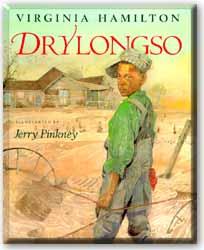
Tuesday's Trait: Ideas and Content highlights the story Drylongso. Drylongso BY Virginia Hamilton Illustrated by: Jerry Pinkey

Drylongso is a realistic fiction story, set in the 1970's. It is the tale of a farming family in the drought-stricken Great Plains or Midwest. The story could have happened in one of the many places with red dirt, including the Oklahoma Panhandle. The ideas and content of this picture book make is a great candidate to encourage and practice effective writing among older elementary students. The story is mature enough that it could be used as examples for middle school students. The big idea of this story is how natural forces can reinforce poverty. The poverty refers to the low economic standing of subsistence farmers, especially among African Americans in the drought stricken region. The poverty is represented by the meager types and amounts of food, lack of water, and other primary needs. Lindy's family in the story Drylongso never went hungry, but they were always on the verge of hunger. This could be a great opportunity to begin a conversation about hunger. First, define: What is hunger? This could be a lively discussion, because some may believe the tiny twinge when a meal is a few hours late describes hunger. Many of them may never know what it is like to be truly hungry and go without food for more than a day. While this could be a tricky topic, you will do well if you ask the students to share their stories in the third person. For example, you could ask, "Do you know anyone who has ever told stories of being hungry?" If they tell stories about themselves, it might be best if others don't know. That is one purpose for using the third person. They may know relatives who lived through The Great Depression of the 1930s, and they can tell their stories. Telling stories would be a great opportunity to develop related projects and tell the stories of your students' families. Students could interview friends and relatives and make a presentation. If your students don't have anyone who might have been hungry, you could use Skype or some other communication device and interview some people who lived through hunger times here in the United States of America or other countries. The secondary, yet important idea of the story is the drought itself. The drought is so pervasively discussed in the story that it really becomes one of the characters. Briefly, yet powerfully, the author discusses the drought using ideas and content that make you feel dry, dirty and tired from all the work that must take place to avoid the major problems of the drought. The description of the dust storm is very realistic. As an introduction to an important character, Nature, Virginia Hamilton does discuss the 20 year cycle of droughts in the setting. The turning point in the story is the dust storm that brings a new character, Drylongso. He arrives as an enormous dust storm spins into the story. His arrival is reminiscent of a modern day, muted Pecos Bill riding a dust devil into town. Drylongso, a boy a bit older than the family's daughter Lindy, is taken in by Lindy's family. They give him water to drink and use to clean his face, and they feed him. Drylongso tells the family how he was separated from his father during the dust storm and became lost. As the conversations continued, Drylongso revealed that he could use a dowsing rod to find water. Then he uses his dowsing rod to locate an underground spring in the dry creek bed that can be used by Lindy's family to help improve their water situation. They can water their animals and their garden, and this new water source is an inspiration for new positive feelings about their situation. Having helped the family, Drylongso says he must return to his father, and he disappears into the West. Characters: Lindy MamaLu Dad Drylongso

Saturday, January 21, 2012

The Internet Grapevine is still local!

Treat your colleagues as you want to be treated. Don't share information that might let others in your local area recognize them. Gather closely for I tell you a tale of poor choices, a tale of a young teacher whose pride overcame her ethics, a sad tale that must be told. I'm the online observer, and I share her tale.

It seems to me that many who use the internet still believe that they are anonymous....that's just not true. One of the teachers in my Professional Learning Network chose to share information about a colleague that was not appropriate, yet this teacher never did understand that sharing without permission is wrong. As far as I could tell, this teacher was spreading gossip.


In the fall of 2011, my Professinal Learning Network was discussing the merits of an individual teacher's form used to help guide student/teacher learning conferences for mathematics. The teacher who shared this form is highly regarded as a technology teacher in our group, yet readily admitted that math is not their strong suit. The negativism and bias of this teacher towards a local colleague seemed shocking to me. I think it may be difficult to trust someone who takes the work of others, downloads it online, and tears the content to pieces.

The teacher in our PLN decided that a colleague's conferencing sheet was not appropriate and shared a link for this conferencing sheet. The irony is that the teacher in our PLN had no problem stealing another teacher's work and sharing this information all over the internet. What was most amazing to me was the fact that they were colleagues in the same school.

Since I didn't know at first that the teacher in our PLN didn't have permission to share the conferencing sheet, I looked over the document. Other teachers also looked it over, since we all share information with everyone in our PLN. Those of us who like mathematics and teaching mathematics found the conferencing sheet to be appropriate tool for teacher use in monitoring student progress. We learned afterwards that the teacher who shared the document with us didn't have permission to do that. I was concerned and frustrated that someone in our Professional Learning Network would do that, yet there it was.

In my experience, teachers collaborate to make a good idea better, but that was impossible because the teachers' work had been displayed online without their permission. Most of those in our PLN believed that some simple changes to the conferencing sheet could help make this a helpful tool for the student. Others thought the form was not appropriate. I thought the form was a very useful teacher tool, yet it could be easily modified for effective student use.

I was shocked that our colleague would do this to a fellow teacher, especially as the teacher didn't know it was being shared among our online group. Without getting permission from the author, it would be unethical to show a copy of it online.

I think it would be a really great idea, if we could consider that the same ethics that guide us at school also guide us, as teachers, when we collaborate or teach online. Ask for permission before sharing a colleagues OFFLINE work. If the work is online and public, you must still attribute the work to the author. This would be a great lesson for all teachers to follow, so they can feel comfortable when teaching online ethics to their students. As the saying goes,
Don't tell me you will do the right thing, show me!

Tuesday, October 26, 2010

For Some, Understanding Math May Always Be Distant Target!

Crossroads by StuffEyeSee
Attribution-NonCommercial-NoDerivs License

For some teachers, even some "good" teachers, understanding mathematics will always be a distant target within a warren of incomprehensible facts and rules. You've heard teachers make statements like: "I never liked Math!" "I just don't understand why this math skill has to be in the curriculum!" "Is this too advanced?".

In trying to understand those who teach mathematics, valid research is available that seeks to interpret elementary school teachers' math teaching success, especially as it relates to their attitudes and capabilities. Take your pick of any of this research on Teacher's Attitudes Towards Mathematics. The idea that many of our peers have a fear of math and lack the basic understanding of what they are trying to teach should not be a surprise.

Therefore, it is easy to understand that teachers who do like and understand mathematics and its place in the school curriculum make up the minority of teachers. Most likely, there will be a gulf between their ideas about teaching math and those of the teachers who are weak in math. Those who "get it" tend to be more organized in their approach to teaching the children, while those who don't get it tend to look for a fluffy way to teach something that is NOT ephemeral. Math has organization, boundaries, rules....

In the elementary school, teachers must understand that all this logic of math is based on the Real Number System. Although it's NOT ROCKET SCIENCE, it's NOT FLUFFY either.

In mathematics, we look for ways to talk about how to solve a problem, but we also MUST support a system of understanding for students. That's where the organization comes into play. The more the teacher understands and feels comfortable with the ideas and facts of math, the easier it is for students to do the same. Then this teacher will help the students, in a concrete way, develop a clear understanding of their strengths and weaknesses. This teacher will use any and all available data provided through testing in the class or the school to bring success in math to all students.

Tuesday, October 12, 2010

A Rose By Any Other Name

a helpful friend by 46137
Attribution-NonCommercial-ShareAlike License


When someone wants to create a stir, make a buck, or earn a doctorate, they give the old wine a new name. Now is no different. Infographics are graphic organizers, sometimes called data visualizations, formerly referred to as charts and graphs.

There are some good examples here, but many of these are very weak in correlating data in a way that makes it more accessable.

Always be careful when you use free websites. Read the fine print of who owns your work, once you've used the web application. Unless they have changed their rules, Many Eyes (owned by IBM) owns your data visualization, so I don't use it.

No matter what, data visualization, oooooops infographics are here to stay. Using the best ones can help us understand concepts better than ever.


Amplify’d from www.makeuseof.com


10 Awesome Free Tools To Make Infographics


Wordle


Wordle lets you create word visualisations using text you enter. There are plenty of interesting designs to choose from. Enter whole books, short passages or see what other people have used. In this example, we can see the US constitution visualised.


Gapminder


GapMinder is a free Adobe Air (cross-platform by nature) application to ensure you have current data on major world issues and can create visualisations for your purposes. Data is updated yearly and released with new versions of the application. The visuals are also quite impressive!


Inkscape


Inkscape is a free vector graphic software available for many platforms. This is the ideal free option for the creation of your overall infographic. Simple and intuitive, you should have no problems importing your visualisations and combining them with other visuals to create your masterpiece.


See more at www.makeuseof.com


Saturday, October 9, 2010

Pull Ourselves Up By Our OWN Bootstraps!

Are there American Education historians who can reach in and define the core issues that plague American Public Education?

Yes, I believe there are! 

The two historians who immediately come to mind are Carl F. Kaestle and David B. Tyack. Their historical analyses of American Schools still resonate and relate directly to our current round of teacher bashing, while we're all "Looking for Superman."


I would like to recommend that you read Opportunity to Comment: Elevate Educators to Professional Status before you read this article. I believe it will provide a clear contextual background for our current dilemma in American Public Education.


June 4th 2008 - Is There An Imposter In My Booth? by Stephen Poff
Attribution-NonCommercial-NoDerivs License
The era of the EXPERT, aka HERO, is over. This is a relief. There are so many of us with wide-ranging experience and education, we can't turn our future over to the "pie in the sky experts". They will only disappoint us.

The teachers in the trenches are also experts, even if they haven't done some quasi-experimental research or written books, simply because they didn't have monetary backing to do it.

Because I believe that each one of us has expertise to share, I will continue to live by my mantra of research:
  • EVERY ANECDOTE IS A DATA POINT
Case in point: My belief in Diane Ravitch, as a defender of American Public Education was destroyed several years ago, yet I'm just as much to blame for letting her slide back into the "role of the great expert".

I've decided not to let that happen. I've decided to make my heroes work for their label.
  • I can't believe in her expertise until I understand that she accepts her role as a power broker in convincing educators to go along with NCLB in the first place. 
  • I can't believe in her expertise until I understand that she has stopped talking the blame game and begins to be more assertive with the opponents of American Public Education.
Here is a sample interview that generally characterizes Dr. Diane Ravitch's viewpoint of her role in the NCLB fiasco.


This interview is OK, yet Dr. Ravitch still doesn't seem to recognize that many in Congress and early adopters were affected by HER initial, and unexpected, support for No Child Left Behind....

In response to her statements in this interview, I've answered some of her concerns:

Yes, I've read your work over the past three years, yet I will continue to have concerns about your recommendations in the future. Mostly because of what I believe is your grave misunderstanding of the real impetus of the NCLB legislation. The entire purpose was to begin the destruction of the American Public Schools.

My core concern is about your lack of understanding of your own power....I really WANT to believe that you didn't understand how powerful you were.

At the time of the first NCLB initiatives, your support was critical because Dr. Ravitch, you are an expert in our profession, at such a level of distinction, that your suggestions carried great weight with lawmakers and educators in our country.

It was such a shock, to me, that you didn't understand the serious consequences of your actions at the time, while many of us NON experts did. It seemed so surreal to me.

The consequences of the actions of this Pandora act will continue to reverberate throughout our American Education system for decades. I just hope a vibrant, American PUBLIC Education System will survive.

Tuesday, July 20, 2010

Tuesday Trait: WORD CHOICE

Have you ever checked your horoscope? I imagine the answer is yes. If so, you know that there are some basic algorithms used to generate your "individual" horoscope. I would suggest that they are a little more accurate than  the possibility of a fortune in a fortune cookie coming true, yet it's all good fun. Well, there is a little meme generator called I Write Like  that's a step up from those fun algorithms, but I wouldn't bet the farm on its accuracy. It's just for fun, and this web application has a useful educational side effect...learning about writing through famous authors.


Just by entering a sample of your writing, you can be assured that your writing will be compared, using an algorithm. The author suggests that

...[c]urrently it analyzes vocabulary (use of words), number of words, commas, and semicolons in sentences, number of sentences with quotation marks and dashes (direct speech).
Your writing will be compared with a basic group of fifty authors, and you will receive a badge with ways to share your discovery with your friends and fans on your blog, Facebook, Twitter and other online networking venues.


I Write Like by Mémoires, Mac journal software. Analyze your writing!

I was intrigued when one of my colleagues shared this web application, so I tried it. I must say that I was unfamiliar with the author that I write like: David Foster Wallace. Once I read a sample of his book, A Supposedly Fun Thing I'll Never Do Again, I understand how his Midwestern choice of words and our shared love of irony could match the "I Write Like" word choice and voice algorithm.

Others in my Personal Learning Network discovered that they wrote like Stephen King, Vladimir Nabakov, Cory Doctorow, as well as Dan Brown.

Some tried a variety of writing samples, and their results were often different. That's where the fun comes into play. It was fun to see which author would be selected using the I Write Like algorithm, and I think your students would think it's fun also. What's even more interesting is that you might just spark a student's interest in learning about various authors.


The I Write Like meme was created by the founder of Coding Robots, Dmitry Chestnykh, who shares basic information about this meme generator, as he expands the number of authors. If you have suggestions, please send them to him at Coding Robots,
a small friendly team of software developers founded in 2002. Our mission is to bring more fun to this world by producing handsome and handy pieces of software.
This meme generator is going viral, so watch for its exponential growth and development. It was released less than a week ago, and people are already interviewing the author, trying to find out the "secret" to the algorithm. Others just never heard that saying, "Don't look a gift horse in the mouth!". They are complaining about such things as the few number of women authors and the variability of the algorithm. If you want to know more, read Dmitry's blog and the comments for the entire story. He would like your comments, as he is planning to add more authors and features.

I would use the I Write Like web application to teach the concepts of Word Choice and Voice using the Six Traits of Writing analytic process and famous authors.

Here are some other Tuesday Trait and Six Traits of Writing articles you may be interested in reading:

Monday, July 19, 2010

n2teaching: Substitutes


letter from a student by evchu.nyc
Attribution-NonCommercial-NoDerivs License
While I've taught more than substituted, I can tell you that substituting is the hardest type of teaching to accomplish. If you plan to truly work effectively as a substitute, here are some ideas that you might want to consider.

The teacher who works diligently to have good lesson plans, deserves a substitute that will effectively use them with the class.

If the teacher leaves good notes, the substitute should leave good notes about what happened through the day.

The substitute stands in for the teacher, and their best philosophy is to help the teacher as well as possible.

Not all substitutes or teachers are equal, so these high expectations may not be implemented by them. Those teachers who have high expectations for the substitute working in their classroom, should request and receive a substitute who agrees with their high standards.

This has always been an important topic, yet it is always helpful to discuss our beliefs about the need and use of effective substitutes.

Wednesday, May 26, 2010

Promote Global WORMING! Activities, Assessment and Feedback


Worms Live Here, Happy, Hungry Worms! by Buffalo ReUse
Attribution-NonCommercial-ShareAlike License

It's time to build a worm home, a vermicomposting container, where you can feed and raise red worms, or tiger worms, that will turn shredded paper and vegetables into new soil for class gardens or potted plants.

This is the culminating event of the "Promote Global WORMING! project. Even though many people have their own methodology for creating worm bins for vermicomposting, I've selected a simple one that can serve as a large group worm bin for an entire class. If the leader, teacher, has enough room, each of the intial four groups would learn the most by making their own worm composting bin to analyze and develop.

Several activities found in the Project WILD Aquatic curriculum guide are related to this study of worm (decomposers) habitats or can be used as extensions. For instance, the "Edge of Home" activity found on pages 75-78, can be used to tie in the connection between aquatic, semi-aquatic and dry land habitats. This activity refers to the study of ecotones, so it would be an excellent extension for upper elementary to adult learners.

Other Project WILD Aquatic lessons and activities should be used or adapted for this project, including another great activity about habitats and riparian areaa, "Blue Ribbon Niche" on pages 52-55. "Wetland Metaphors", on pages 39-42, would help students understand more about the productivity of wetlands where earthworms are part of the decomposer species.

Each group will follow the directions provided and create their own worm bin. Young students will need adult assistance drilling holes in the top bucket. A list of supplies is listed in the instructional website: How To Build An Indoor Worm Composter. This activity is an adaptation of the Project WILD Aquatic project, "Designing a Habitat", found on pages 18-20.

Enjoy the final activities and assessment. Your completion of the feedback survey at the end of this post is greatly appreciated in advance.

Students will:
  1. create a habitat where earthworms, red worms, can thrive and reproduce. The assessment for this objective will be journal keeping, including picture taking until the worms reproduce.
  2. create a graph or chart to measure inputs...the stuff to put in the worm bin.
  3. create a comparison graph to measure outputs...the newly created soil, worm eggs and young worms.
ACTIVITY #1: Using the instructions provided, students will create their habitat. Take pictures to include in their Worm journals. Using this setup described in the directions will eliminate excess "brown water" or fertilizer, and the students will measure the initial inputs, including:
  • worms
  • shredded paper
  • empty buckets
  • vegetable matter
  • any other inputs
As the learners begin journaling, the leader, teacher, would be well served to adapt the Project Wild Aquatic activity, Aquatic Times, found on pages 188-189. The classroom product could be called Decomposer Times or a similar name. Let the learners brainstorm names and vote on the top 5 favorites.

ACTIVITY #2: Each day, student(s) will measure and journal the amounts of added inputs. Students will add pictures to their journal. This activity lends itself to an online journa, including a class wiki.

ACTIVITY #3: When students observe water in the bottom bucket, they should begin recording this in their output charts. Note how long it takes to collect a liter of water, and answer questions such as:
If we aren't adding water to the composting bin, how is it draining into the bottom bucket?

ACTIVITY #4: As students observe the worms in the bin, they will discover eggs and young earthworms. They can include this in their journal writing and take pictures. They will answer questions such as:
How many days did it take for the worms in our bin to reproduce?
How does that compare or contrast to the other groups worm bins?
If there was a significant difference in time needed for worms to reproduce, what may have caused the differences?

Activity #5: This will be the time to have each group share their findings in any type of presentation they choose. After their creations and presentations are given, then given them the post test discussed in the first posting, Promote Global WORMING! Prior Knowledge and Post Project Assessment.

Whenever learning occurs, it's always wonderful to have feedback, so prepare a short survey to answer the questions you may have for your students. This survey was adapted from a more comprehensive Project WILD Aquatic workshop feedback survey. If you would like a copy of the more extensive feedback survey, email me.


Promote Global WORMING! Graphic Organizer

ImageChef Word Mosaic - ImageChef.com